

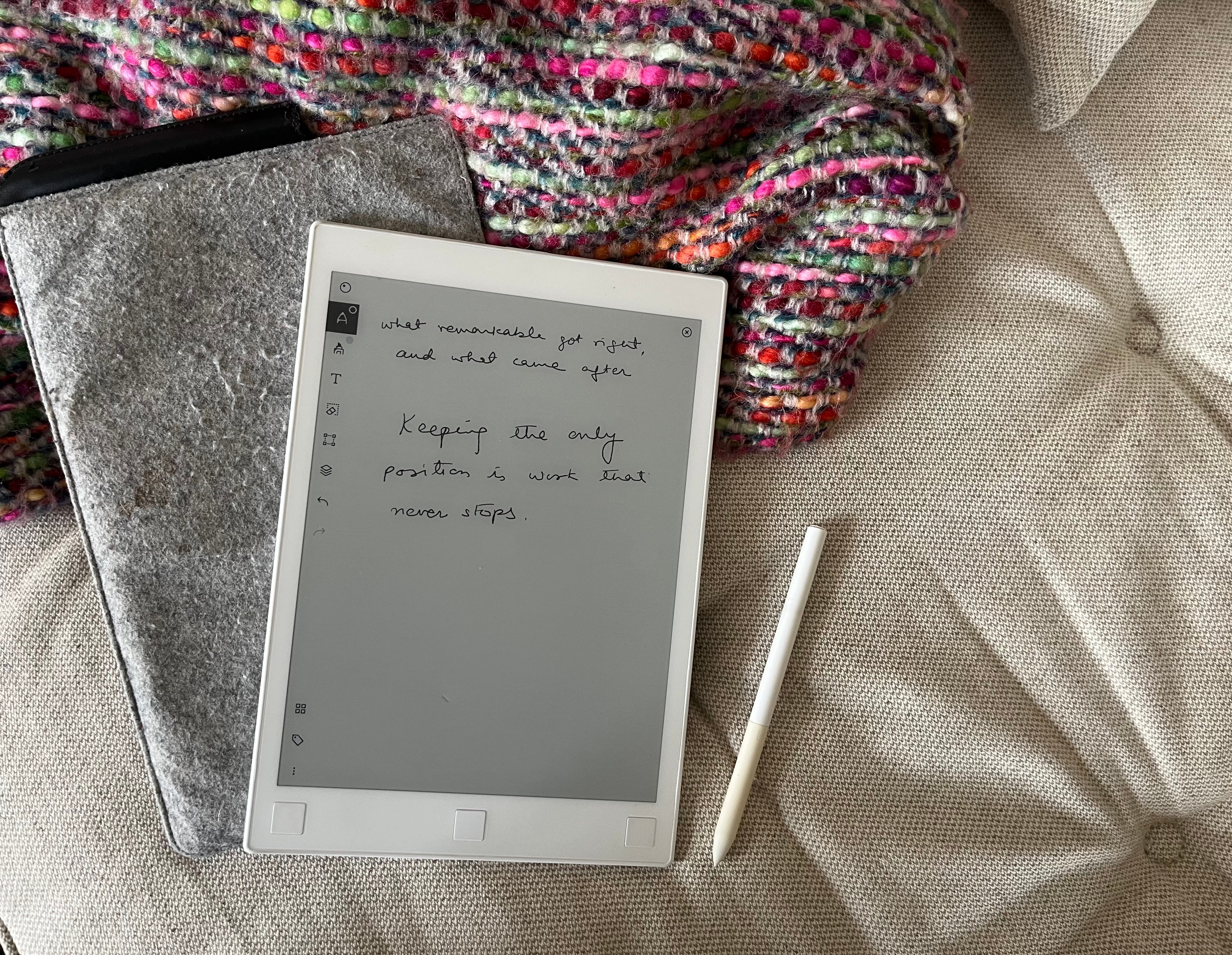
I became a beta user of reMarkable in 2017. Almost nobody had heard of them then. A Norwegian company making a tablet that was supposed to feel like writing on paper, with no email, no browser, no notifications. Just a screen, a pen, and the thing you were trying to think about.
I have used a reMarkable ever since. Nine years. I am writing notes for this article on one right now.
Everything that follows is the view from outside. I have never worked at reMarkable. I have no idea what discussions have taken place inside the company, what trade-offs the management weighed, or what they knew that I did not. All I have is what every customer has, the product in my hand and the stories I have read in the press. This is one customer, who happens to also be a founder, trying to make sense of what I have observed.
Start with the simplest picture of a business. Someone wants something (demand). Someone else provides it (supply). When the right supply meets the right demand a transaction happens. Do that repeatedly, at a cost that leaves something over, and you have a business. That is the simplest explanation. Everything else is details.
Now picture demand on one axis and supply on the other, low to high on each. That gives you four quadrants, and almost every company you can think of sits in one of them.
Low demand and low supply is the bottom-left corner. Not many people want this thing, and not many people make it. There is usually a reason both are low. The need is not strong enough yet, or it does not exist at all. Most new ideas start here. Some of them stay here forever. A lot of startups die without ever leaving this corner because they built something nobody actually wanted.
High supply and low demand is the graveyard. Lots of people make this thing, not enough people want it anymore. Companies in this corner are fighting each other for customers who are not really there. Most go out of business. This is what happens to a category after the demand has faded but the supply has not yet caught up to that fact.
High demand and high supply is the busy corner. Lots of people want it, and lots of companies make it. This is where most companies end up. The product is there, the market is proven, but you are one of many suppliers. Customers compare you against the others on price, on features, on delivery time, on whatever they can compare. You compete on the margins. You can build a business here, but it is hard work and there is always someone underneath you on price.
And then there is the corner every founder aims for, whether they say it out loud or not. High demand, low supply. The market for a given need or want is proven. Almost nobody else provides it. You provide it in a way that your customers cannot find anywhere else. You are not a better version of something, you are the only version of something, and for a specific customer there is no real alternative to you.
Alex M H Smith, a strategy expert and my esteemed teacher, said this better than anyone.
Being the only is better than being better than others.
That corner is the prize. It is also rare, because reaching it requires a discipline most companies do not have. You have to decide who you are not for.
This is the thing reMarkable did better than almost anyone.
Most companies cannot bring themselves to narrow. They want the big market, the broad appeal. They look at a larger audience and cannot say no to any part of it, so they build something a little bit for everyone and end up being the only choice for no one.
reMarkable did the opposite, early and on purpose, it seemed. They were not building a tablet for everyone. They were building it for a particular kind of person. The writer. The thinker. The creative who wanted to get away from the screen they were already on all day. Someone who would pay for focus, for a beautiful object, for the absence of everything a normal tablet does.
The branding was disciplined in exactly the same way. The ads were calm and confident. They were not shouting about specifications, they were showing you a different way to think and trusting the right person to recognise themselves in it.
One of their first ads was called Get your brain back. I still send people to find it on YouTube when I want to show them what good branding looks like. It did not sell a device. It named a problem the right customer already felt, and it made reMarkable the answer to it. I watched that ad and recognised myself.
By around 2020 to 2022 reMarkable had what most founders only talk about. For the customer they had chosen, nothing else came close.
And then they had to keep it.
Here is the part that is easy to miss, and I think reMarkable missed it too.
The only position is not a trophy you win once and put on a shelf. It is a job. It has to be done again every year, because the moment you occupy that position you have told the whole market exactly where the demand is. Competitors can see it now, and some of them will come.
Holding the position means working on hardware, software, and pricing at the same time. Let any one of them drift and the position starts to go, even if the other two are still excellent. Customers do not experience your company as three separate things. They experience it as one thing, and one thing is only as good as its weakest part.
reMarkable kept working on the hardware. New devices, new models, a steady cadence of releases. That part got attention.
The software did not keep up.
The hardware always felt thought through. The software often did not. There were two separate desktop applications and it was not obvious which one did what. The usability was weak in a way the hardware never was. It improved slightly over the years, but it never felt as premium in the hand as the device itself. For a company whose whole promise was a seamless, calm experience, the software was the part that did not feel that way.
And while the software drifted, the price went up.
This is the part that should have worried them. I am still using my old reMarkable, the one from 2017. There were moments when I looked at the newer models and thought I should upgrade, but I did not do it. The price was too high for what the upgrade offered me.
That is worth sitting with. I am not a reluctant customer. I am a nine-year fan, the exact person they built the company for, someone who recommends their old ad to strangers. And even I, looking at the newer device, decided the price was not worth it. When your most loyal customer starts saying no to the upgrade, the premium is no longer doing the job a premium is supposed to do.
I want to be careful here, because I am only looking from outside. What I could see was this. reMarkable was hiring quickly. The number of employees in strategy, design and engineering grew several times over in a short time. The spending looked generous. There was a striking, one-of-a-kind office building planned in Oslo that everyone was talking about.
A premium price can mean two completely different things, and from outside they can look the same.
It can mean we are the only ones who do this. We charge this because there is genuinely nothing else like it, and the price is part of how we keep the category narrow and the brand intact. That is what reMarkable’s price was in 2018. It was earned. It matched the position.
Or it can mean the company has grown to a size where it now needs the price to be this high. The team got bigger, the spending got bigger, and the price has to stay high to cover it. The price is no longer saying we are the only. It is saying we cannot afford to charge less.
From outside, in 2022 and after, I could not tell which of these reMarkable’s price had become. That is the warning sign. When you can no longer tell whether a company’s price is set by the position or by the cost of running the company, something has already shifted.
Some of the original discipline is still visible. Their newsletters today still sound like the company that made Get your brain back. They write about focus, about working without distraction, about thinking clearly. They mention new features and new hardware sometimes, but not as the main thing. The brand voice has held. Someone in that company is still protecting it, and it shows.
All of this was happening while the supply side of the picture filled in.
Amazon’s Kindle Scribe arrived. Boox. Others. Closer in hardware than reMarkable’s customers expected anyone to get, and priced lower. The customer who in 2018 had no alternative now had several.
This is the pattern, and it is not unique to reMarkable. A company finds real demand. The supply is scarce, so the first mover wins customers quickly. Then others see exactly where the demand is, because the first mover showed them. They build. The category fills. The company that was alone in the high demand, low supply corner gets pulled into the busy corner with everyone else. And unless it has made itself genuinely hard to replace, the competition shifts to price, and the only position stops being only.
reMarkable had a real chance to be hard to replace. The brand was a moat. The hardware was a moat. But the experience that justified the premium was not only those two things, it was the whole thing working together, and the software was the part that did not keep pace.
So by the time real competitors showed up, reMarkable was charging a premium price for a product that no longer felt premium all the way through. The hardware still did. The software did not. A customer notices that before any quarterly report does. They notice it when they look at the new model, think about the price, and decide to keep the one they already have.
I am not writing this because reMarkable failed me. They did not. I am still a customer. I am writing it because reMarkable did the hardest thing first, and may have mistaken it for the whole job.
Deciding who you are not for, narrowing to a specific customer, building a brand disciplined enough to hold that line. Most companies never manage it. reMarkable managed it beautifully, and that deserves to be said plainly.
But the discipline that gets you to the only position is not the same discipline that keeps you there. Getting there is a decision. Staying there is maintenance, on every front, forever, against competitors who now know exactly where to aim.
If you are a founder good enough to reach that position, you are also exactly the founder at risk of this mistake. The entry to the only position may have felt like the achievement. It was the beginning of the actual work.
The first sign of trouble is not in the numbers. It is in the customer you built the company for. They notice when one part of what you make stops keeping up with the rest, and they look at the new version, and they decide not to buy it.
I am still using the reMarkable I bought in 2017. I never replaced it. For a company in the only position, that is not loyalty. That is a problem.
• • •
I am writing a book, The Avoidable Startup Failure: How good companies lock in failure long before money runs out. It will be launched in August 2026. You can sign up here: https://anjali.no/book