Last week I was talking to a room full of tech founders. I put a statement in front of them and asked them to score how much they agreed with it.
Idea is not worth much. Execution is everything.
Most of them agreed completely.
For most of my career I would have scored it the same way. You need an idea to start with, of course, though I believed the idea itself was rarely the thing that decided whether a company succeeded. Execution was.
I had plenty of evidence for this belief. I had watched companies with ordinary ideas outperform companies with seemingly brilliant ones because they executed better. They moved faster, understood customers better, made fewer mistakes and simply got more done. I had built my career around execution, and I had been told repeatedly that it was one of my strengths.
I don’t believe it anymore. I told the founders in the room that, and explained why. I think I could see some minds shifting as I made the argument.
I started questioning this after reading Alex M H Smith. He is the bestselling author of No Bullsh*t Strategy and, in my opinion, one of the best strategy thinkers working today. Reading him led to a series of conversations between us, where I argued with him for quite a while. I had twenty years of experience to point to. He had a different way of looking at the problem.
Eventually, he changed my mind.
The more I have thought about it, the more I think the issue is not simply that AI is getting better at execution. It is that we are living in a world of abundance.
Look around. In the Western world, most of our basic needs are already being addressed, and so are an extraordinary number of our wants. There are restaurants, hotels, financial products, productivity tools, entertainment platforms, education services, health products, clothing brands, software applications and delivery services for almost anything you can think of.
There is no shortage of things, and we have become remarkably good at producing more of them.
When several companies are pursuing essentially the same idea, the obvious way to compete is to execute better. Build faster, make it easier to use, lower the cost, improve the service and acquire customers more efficiently.
This is not a bad thing. A huge amount of value has been created this way. It assumes something that is becoming less true, which is that good execution is scarce.
AI is not the only thing changing that. Human inertia has a lot to do with it. Once a category exists we tend to keep improving the category, and once a business model works others copy it. New companies enter the market offering essentially the same thing with a slightly better experience, because that is the thing everyone knows how to do.
AI is accelerating the process. Knowledge that used to require years of specialised experience is becoming easier to access, work that used to require teams can increasingly be done by individuals, and products, content, code and analysis all move faster than they did two years ago.
We are becoming extraordinarily good at execution.
Which raises a question I find much more interesting than whether AI will replace this or that job.
If execution is becoming abundant, what should innovation be about?
I think this is where the idea makes a comeback. Not any idea, but one that is genuinely different. An idea that is not another version of something already in the market, and a point of view that is not borrowed from the category you happen to be in.
That kind of thinking is difficult to automate, because its value comes precisely from being uncommon.
There is something else going on here. If everything around us becomes easier to produce, the value of what is scarce increases.
We have lived through an extraordinary period of optimisation, where we became very good at taking an existing idea and making it better, faster, cheaper and more convenient. The next period may reward something different, where the advantage comes from seeing something other people have not seen.
This is where Alex’s thinking becomes relevant to my book, because there is a catch.
A genuinely original idea is also a bet on something that does not exist yet. A strategy worth having is a hypothesis about a future that has not happened. The more unusual the hypothesis, the less evidence you have to support it, and the further you move away from what is known and into territory nobody has mapped.
That is where the danger sits.
As Alex writes in the foreword to my book:
“The more you commit to an idea that is truly unique, meaningful, and impactful, the further you are pulling yourself into the realm of the unknown. The realm of danger.”
This is the part I have become interested in. We have become very good at execution and we are getting better at it all the time. If the next source of advantage comes from ideas that are genuinely different, we also have to become better at dealing with the uncertainty that comes with them.
That is what my book is about. It is not a way to guarantee that an idea will work, because nothing can do that. It is about finding the assumption that would kill the company, and testing it while being wrong is still cheap.
Alex is one of the reasons I wrote it. I spent four months working on it day and night, and there was only one person I wanted to ask to write the foreword. He very generously said yes, and I am very glad he did.
If you do not know his work, I recommend starting with No Bullsh*t Strategy. He also writes The Rare Mind on Substack, which is one of the best places I know to encounter genuinely uncommon thinking.
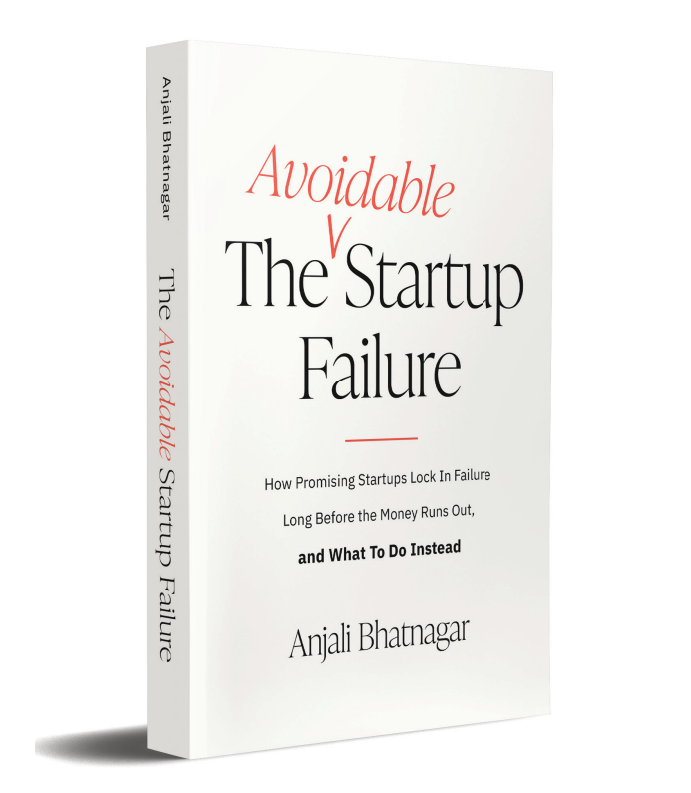
My book is called The Avoidable Startup Failure. It is out now.
- In Norway : https://anjali.no/book
- Everywhere else: It is on Amazon, in Kindle and Print version.