

I used to think strategy was for PowerPoint people.
Then I watched what happens when you run a company without it.
My understanding of strategy began in large companies.
Every year, the same cycle: long workshops, post-its, consultants, and a new framework everyone swore by.
One year it was Balanced Scorecards.
Another year, Good strategy, bad strategy by Rumelt.
We spent months connecting boxes and arrows across departments.
When the work was done, the slides went to SharePoint or in some cases, transferred to a poster and hung on the wall and no one looked at them again.
Strategy was something we produced, not something we used to make daily decisions.
In startups, the pendulum swings the other way.
No slides, just motion.
Sell harder. Add features. Raise more money.
Different theatre, same absence of clarity.
So, due to all the implicit misunderstandings, I’ve decided to drop the word strategy for a while, and call it what it really is:
the approach you choose to win your game.
Why you need an approach
Strategy is the approach you choose to win your game.
It is about maximising the value your business provides to your customers and to you.
Once that approach is clear, it becomes a powerful way to align every action and every person in your company.
Without it, more resources do not always produce more results — a truth I learned in my first ten years at Telenor.
Big companies have more people and budgets, but that rarely means they are more aligned.
In startups, alignment comes naturally at first because you are few, the mission is clear, and all effort goes into getting your MVP and first paying customers.
You move fast because you share a common urgency.
But then something happens.
You think that the same rules still apply.
So you sell harder, add more features, raise more money, hire more people, and sell harder again.
Still the speed slows down, and the clarity is gone as more problems appear on the surface.
You keep playing the same game and keep expecting different results.
The board you are playing on
Before you can win, you need to name your game.
What demand are you serving, and what supply are you part of?
Every business plays on the same board — the intersection of supply and demand.
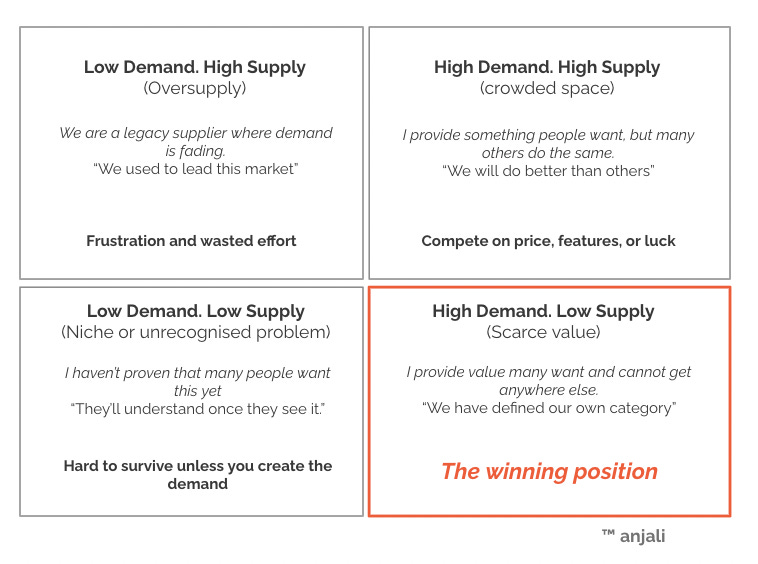
The goal for every company is to move toward the high demand and low supply corner, where you provide something that many want, in a way they cannot get anywhere else.
High demand and high supply
Some startups begin here, in markets that already exist, where customers already spend money, and where many others are doing the same.
If that is your starting point, it is usually based on conviction that you are providing value in a better way.
And let me tell you, “better” is the enemy of clarity.
In this quadrant, you feel safe, but it is also the toughest place to compete.
You enter a crowded room where larger players often have more money, brand, and endurance than you.
You might tell yourself, “We’ll move faster” or “We’re solving it better.”
That can attract innovators and early adopters, but if you do not consciously place yourself in a different category, one that customers do not compare with existing solutions, you will struggle.
Speed alone does not help if customers still see you as one of many.
You have to change the shelf you are standing on.
A clear example is ecommerce of regular consumer goods.
Everyone sells the same products with the similar margins, the same campaigns, and the same delivery promises.
Everyone is technically succeeding, but no one is really winning. It is a zero sum game.
Low supply and low demand
Most technology based startups actually start here.
Supply is low because the product or concept is new, and demand is low because the problem is not yet defined or recognised by most.
You have a solution, but you have not proven that many people want it yet.
Sometimes you believe you are offering a new opportunity that users simply do not see yet.
In this quadrant, founders often say, “People will understand once they see it.”
So they start educating the market, one conversation at a time.
With a small chuckle I can say that my own business lives here. ;-)
The demand for what I offer should be high, but only a few founders and investors recognise that yet.
It is a typical founder syndrome: we see the problem clearly, but the world has not caught up.
To gain traction, many founders here start competing on price to make users aware of their solution.
The intention is good, but it rarely works.
By focusing too much on price, they unintentionally push themselves toward the crowded quadrant of high demand and high supply.
For most customers, price is not the deciding factor.
Trust, reliability, and perceived value matter more.
When people do not fully understand what you do, lowering your price does not help.
Clarity and differentiation does.
Moving your chips toward the winning corner
The goal is not only to be in the high demand and low supply space but to be perceived as someone who stays there.
That perception depends on where you start.
If you are in high demand and high supply, your task is differentiation. Change the rules so you are no longer seen as one of many.
If you are in low demand and low supply, your task is education. Make people aware that the problem exists and that it is worth solving.
You can use several levers to move your position:
Product: what you choose not to offer, and therefore become known for
Communication: how you frame the problem and describe what winning means for your customer
Partnerships: who you collaborate with to borrow credibility, volume or unlock new value
Distribution: how you reach people in ways others cannot or will not.
Which of these you use, and how you combine them, depends on your market and stage.
That part is, well, my trade secret but I will come back to this, one post at a time. :)
What’s next
Over the next few weeks, I’ll use this quadrant framework to look at a few Norwegian startups —placing them on the supply–demand map and analysing what game they seem to be playing, in my experience, mostly unintentionally.
Not as critique, but as learning.
If you’d like to follow that series, make sure you’re subscribed here:
Get new essays each week on clarity, growth, and how to play your game to win.
I am in the process pf building my reader base and therefore all shares are very much appreciated.
Previous posts
If you missed my previous posts in this series, here they are:
When we didn’t have strategy — nobody asked for it, and nobody missed it, Oct 29, 2025
What happened after Tørn — and what I’m doing now, Oct 22, 2025